
I have always wanted a panoramic camera. It all started during my studies when a class assignment introduced me to the concept. Back then, I would take half a roll of photos, carefully stitch them together on a piece of cardboard, and marvel at the resulting wide compositions. It was a rewarding process, even if it felt more like assembling a scrapbook than traditional photography.
Later, during my time with the Nikon D80, my approach to panoramic photography took on a new dimension. I went from stitching together over 60 digital photos into massive images to crafting minimal 360-degree panoramas using just six shots with a 10.5mm fisheye lens. The possibilities felt endless, and my fascination with ultra-wide imagery only grew stronger. See Nikon D80 panoramas gallery.
When I fully returned to analog photography, I explored different ways to rekindle my passion for panoramic shots. I experimented with stitching two to three images together and even modified my medium-format Diana to use 35mm film. These were fun experiments, but they never truly captured the immersive feel I was after.
I was enamored with cameras like Hasselblad X-Pan or Fuji GX617, but never gathered enough excuses to buy them. Instead, I turned my attention to alternatives like the Widelux and Horizon, inspired in part by the stunning photo albums of Jeff Bridges. I had heard rumors of a Widelux revival, but when I stumbled upon a Horizon 202, I knew I couldn’t wait any longer.
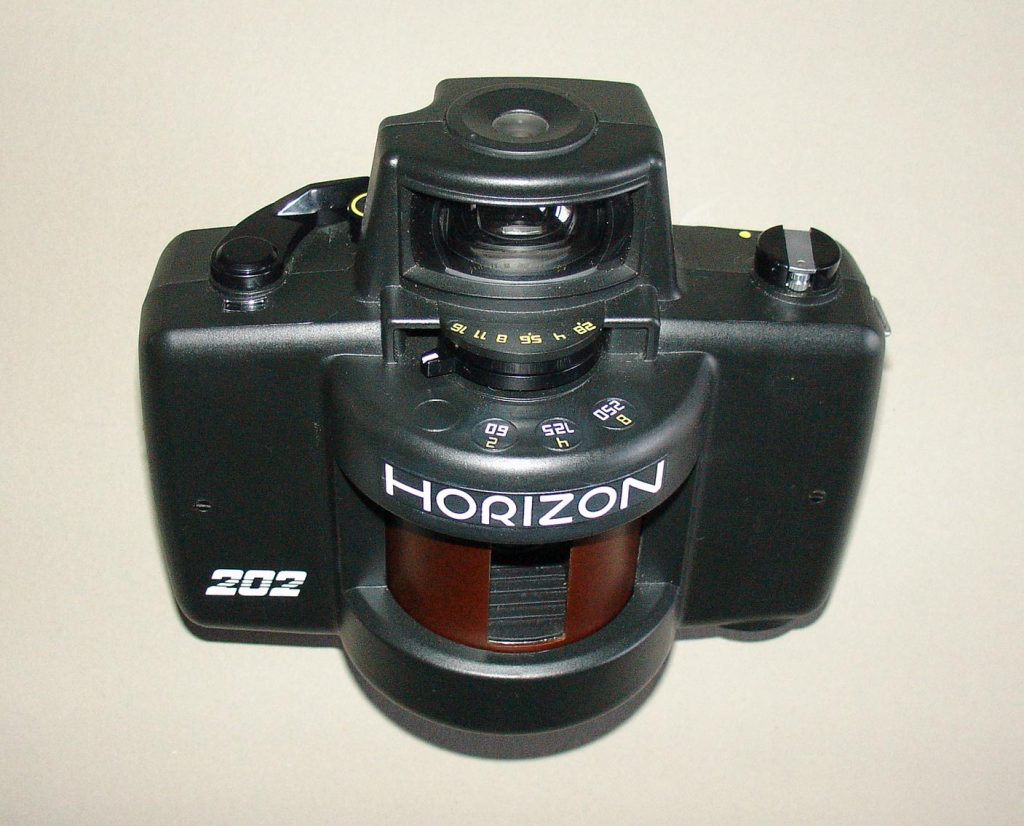
The Horizon 202, the most common model in the series, was manufactured by the Krasnogorsky Mechanichesky Zavod (KMZ) between 1991 and 2003 as a successor to the older Horizont. Like its predecessor, it captures stunning 24 x 58mm panoramic photos on standard 35mm film. While it may not be considered a classic camera, it is certainly notable for its enhanced features, including three additional slow shutter speeds, a lighter ABS plastic body, and a built-in viewfinder conveniently placed at the center of the top plate.
Owning the Horizon 202 has finally allowed me to achieve what I had long sought—a seamless and immersive panoramic experience in the world of analog photography. That said, the camera is far from perfect. Its rotating lens mechanism, while fascinating, can be finicky, and the plastic body, though lightweight, feels fragile at times. Light leaks and uneven exposures are not uncommon, adding to its unpredictable charm. The viewfinder isn’t always the most accurate, making composition a bit of a guessing game. But despite—or perhaps because of—these quirks, the Horizon 202 has an undeniable character. It may not be the most prestigious panoramic camera out there, but for me, it represents the perfect balance between accessibility, imperfection, and sheer creative joy.